
December 6, 2025 | 9:26pm ET
By Mike Cranwell, TheFourthPeriod.com
TORONTO NEEDS THE POWER OF THE THIRD
Getty Images
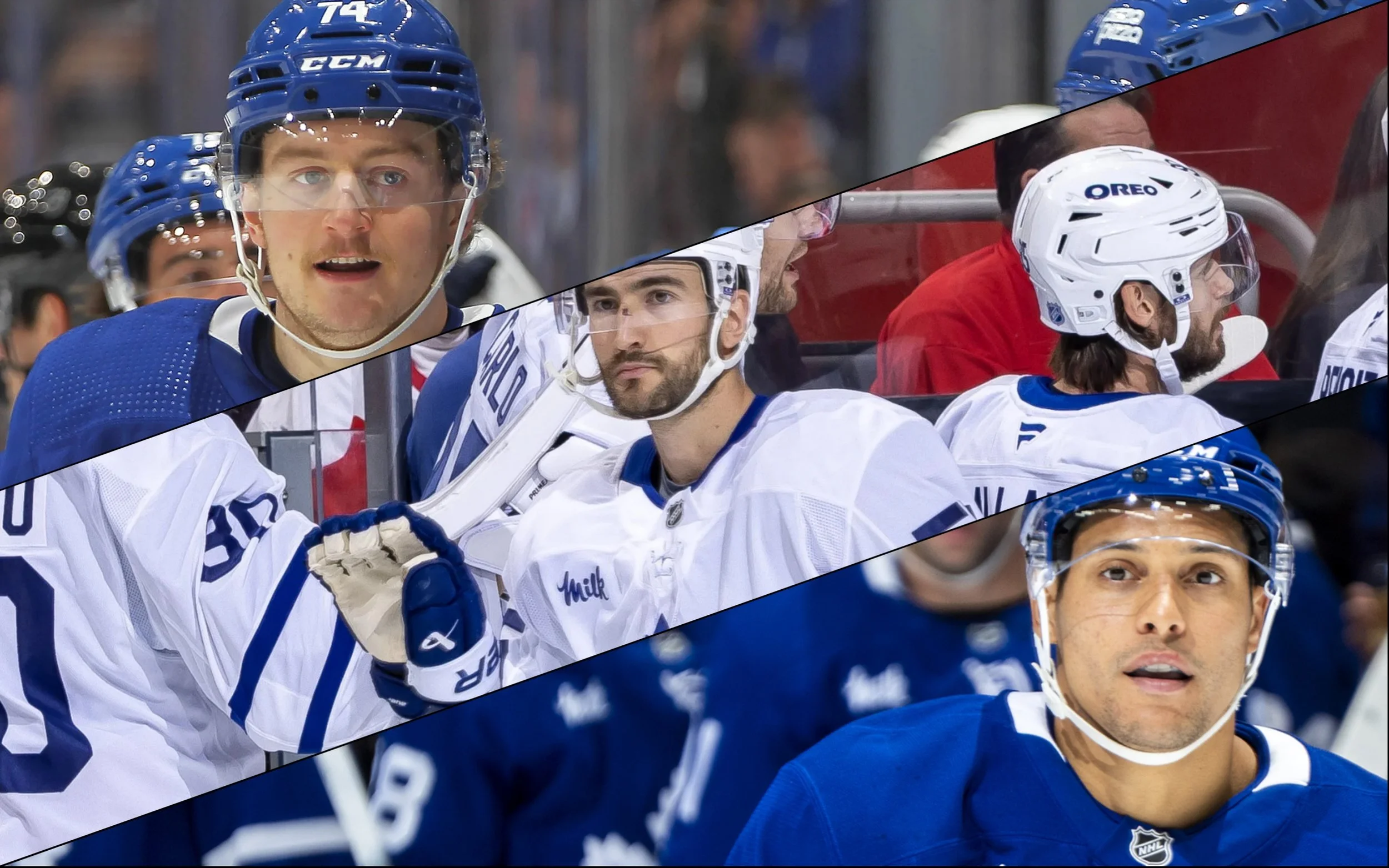
Bobby McMann, Nic Roy and Dakota Joshua
I can remember it like it was yesterday: Sitting around the coaches’ office, Head Scout of a Junior team, alongside the Head Coach and coaching staff, the GM, and our two owners. It was the night before an important day in our season, and we had decisions to make.
During this conversation, for whatever reason (read: it was bothering me) I mentioned how early in the year, part of what had made our team so effective was our third line. We had a cerebral center who was balanced offensively and defensively, good enough to play a top-six wing role, however, was a true glue guy, ideal for 3C, and thus most effective leading a third line. We had a left winger who was a wrench, could do anything, play with some speed, some grit, win puck battles down low, score a little, and was defensively responsible. Then, we had our right winger, who was basically the Tasmanian Devil with a hockey stick. Like Ricky Bobby, he knew one speed: FAST. He shot the puck hard and at will, he hit harder than most players in the league. He wasn't perfect, but when he was on, he was a flat-out weapon.
Early in the year, we used this trio as our third line, and it was a huge reason why we’d gotten out to a 5-1 record to start the season. Once our starting goalie went down with an injury, the head coach (the brother of a longtime NHL defenseman) started tinkering, as they are known to do, and that meant this line was both split up and forgotten about. So, for some reason, in front of the entire leadership group, I decided that this meeting was the perfect time to soft-pitch putting them back together.
Why am I talking about a third line from the past? Well, because I view NHL hockey teams through a single lens: Can they win the Stanley Cup this year? That’s it.
Go back through time, and you’ll find that every Stanley Cup winning team had a third line that was something of an identity line. Most people have heard the story of Pittsburgh’s 3rd Cup win of this era, where they went to Phil Kessel, asked him to play a 200-foot game, and put him on a third line with Matt Cullen. That line dominated each series (especially the final three), Kessel arguably should have won the Conn Smythe, and Crosby & Co. were champions yet again.
Tampa Bay had their Goodrow-Gourde-Coleman line that shut down the opposition and scored timely goals, all while playing too fast and too furious for opposing teams to keep up with. Vegas had a third line with original misfits William Karlsson and Reilly Smith, who would have been a second line on virtually any other team (the high-end depth concept I discussed in an earlier article) who could both score and keep the other team off the scoresheet. And who could forget Florida’s third line last year, Luostarinen-Lundell-Marchand. A young player who’d been a 4th liner on the previous year’s Cup winner stepping up, a young star who would be a second line center on a good team, and an aging not-quite superstar (at his peak), world-class leader and pest, who, coming off a major injury, played down the lineup on his off-wing and was still able to elevate the kids. As the playoffs got tougher, that line got better.
On and on it goes, history is littered with these dominant third lines on championship-winning team.
So, let’s jump in time to this past Tuesday’s battle for last place in the Eastern Conference, when most of the Florida Panthers hosted the decidedly iffy Toronto Maple Leafs.
During the preseason, there was some talk about the Leafs having a third line of Bobby McMann - Nicolas Roy - Dakota Joshua, which was all I wanted to hear because that, so clearly, was the line to make. McMann would bring the speed and scoring with a side of physicality, Joshua would bring the physical presence who could score and play 200-foot hockey, and Roy was the glue, the balance, the NHL version of the center I described above.
During the game, TSN showed a graphic illustrating how unproductive each player had been in the previous six games. Why? Because in this game, Toronto’s new third line was dominant, caving in Florida and scoring two goals in a 4-1 win. Joshua, much-maligned over the first quarter of the season, had a goal and an assist along with strong 200-foot play (often the first forward deep in his own zone, covering a lot of space defensively from below the faceoff dot to the blue line), Bo had two assists and three hits, and while Roy was scoreless (sure looked like he tipped that first goal in), he won 80% of his faceoffs and his 23 shifts was tied for the fourth most with Matthew Knies and only behind the Matthews-Nylander-Tavares triumvirate. Exactly what you’re looking for from a true, ice-tilting third line center and third line overall.
Regardless of the roster that Florida iced, this for me was Toronto’s most complete game of the year. You constantly hear the media drone on about playing 60-minutes. It’s a misnomer, especially in a league with as much parity as the NHL currently operates with, it’s unrealistic to play your game and constantly be winning battles all over the ice for 60-minutes.
The other team has good players too, after all. A true 60-minute game is bringing effort and sticking to the game plan, consistently, all game. So the fact that Toronto was able to play such a strong overall game for 60 minutes, especially with Matthews continuing to be something short of the former MVP gamebreaker that he once was, and with William Nylander clearly under the weather, speaks volumes about what the team was able to accomplish (to say nothing of their fantastic fourth line of Steven Lorentz - Scott Laughton - Nick Robertson, who also hit the scoresheet on this night).
The belt (Toronto gives away a replica WWE title to their player of the game) for the night should have gone to that entire third line, as they led the way. The fact that it took until 1/3 of the way through the season, to December for this to happen, however, speaks to a different issue.
What shocked me looking at the score sheet was the time on ice for each member of this line.
Roy: 16:21, 23 shifts
McMann: 13:34, 20 shifts
Joshua: 11:07, 19 shifts
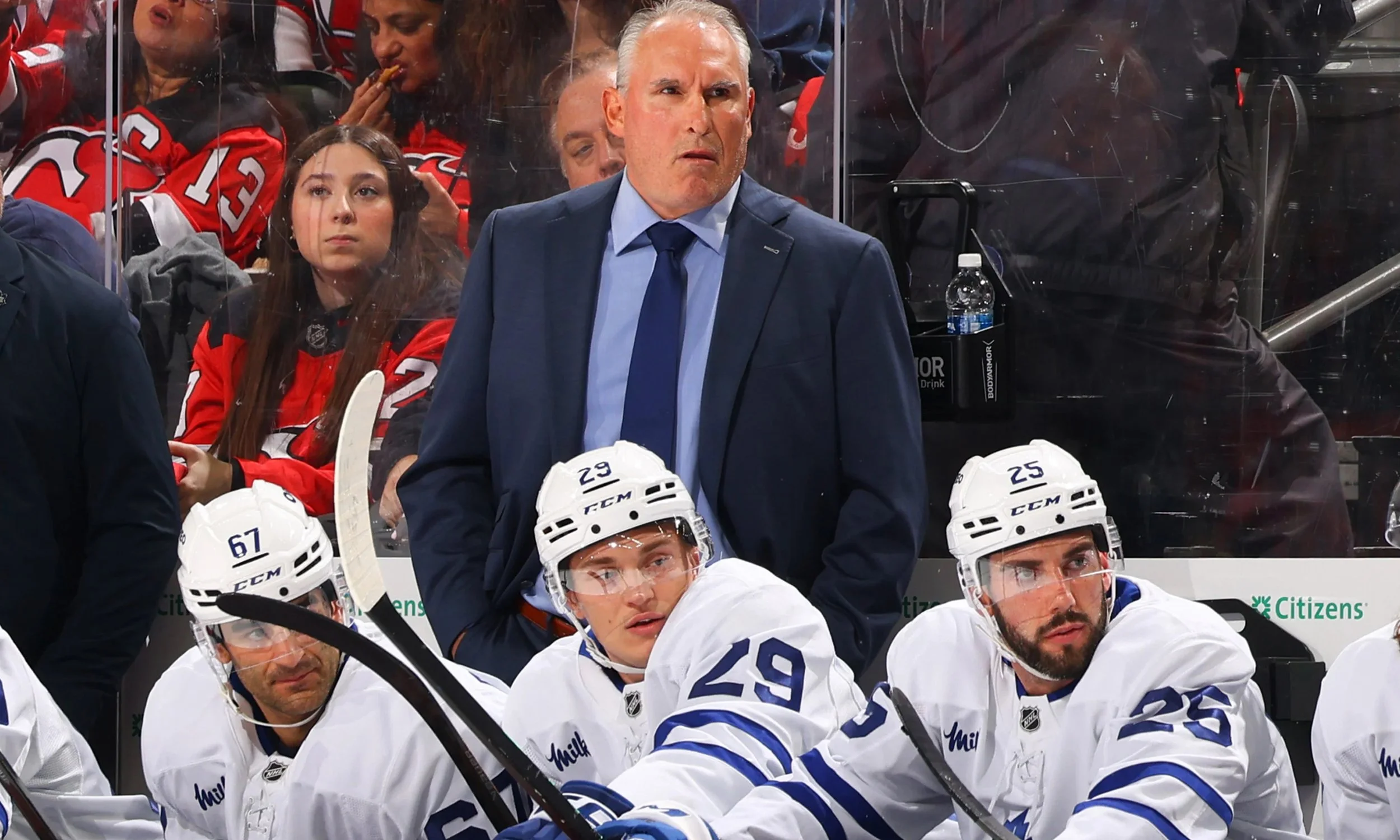
Overloading your top players, especially in a game that Toronto clearly had in-hand, with Matthews and Nylander not 100%, Tavares being overplayed recently, and with their third and fourth lines going, was not necessary. It’s something that is commonplace on this team however, because Leafs’ Head Coach Craig Berube hasn’t had third and fourth lines that he can trust. Well, now he does, which brings us to a 3rd line-adjacent topic that goes all the way to the top!
People talk about Berube having shortcomings, but rarely does anyone actually say what they are. To my eyes, a major issue is that he’s not strong at putting lines together.
Case in point: Matias Maccelli.
Watch his game closely – whenever he gets back in the lineup – and you’ll see a true playmaker with great on-ice vision, someone I guarantee you GM Brad Treliving acquired in part because he gave off Poor Man Marner vibes. A left-hand shot, Berube almost always has him playing right wing. This has made it nearly impossible for Maccelli to make the passes/plays that his above-average vision and skill should and normally would allow him to. Plus, oftentimes sticking him with Joshua because Maccelli played with Lawson Crouse (also big, more skill than DJ) in Phoenix is a classic form of coaching group-think that completely eliminates a coach’s ability to be creative with lines. Especially when it didn’t work in Utah last year, which led to Maccelli being available in the first place. Doing this negated the ability of both Maccelli and Joshua to play their respective games and took away any ability to field a quality third line.
By comparison, look at Paul Maurice in Florida. Matthew Tkachuk: Left-handed shot playing right wing. He did some of that in Calgary, you say? Fine, they still put him there in Florida and, well, it worked. Marchand, definitely a left-winger in Boston, former 100+ point player at LW, multi-time All-NHL LW, playing third line right wing in Florida. I bet many old-time coaches saw that setup at the start of last season’s playoffs and blew their stack. And yet, it worked, it worked to the tune of winning the Stanley Cup (and that third line had more to do with it than Barkov, Tkachuk, or the playoff version of Goalie Bob, let's be honest). Creative, outside-the-box thinking succeeds.
Clearly, Maccelli, who is currently a healthy scratch because he flat-out doesn’t work as a right-winger and his play/production this year shows that, needs to be on the left side. So, using the Maurice Model of Creative Coaching, what’s stopping Berube from going to Knies and saying "Hey, we want to try the Tkachuk model with you and put you on right wing. You can still crash-and-bang, and it shouldn't affect your net-front play much. This will alleviate any pressure on you to create for Matthews, and you can still play your style of game. Maccelli will go on the left side, and he will set both of you up all day like Marner used to." Then, put Maccelli in the LW spot, and you can find a way to trade Max Domi, who, part of Toronto royalty or not, and I absolutely, unequivocally love parts of his game, is simply not a guy a team can win with.
To this point, in the rare instances where Maccelli has played LW with Tavares and Nylander this year, they have had some very real moments where they bury opposing teams deep and show the ability to score goals. The line ultimately doesn't work because no one there has a true physical presence, but as proof-of-concept, it shows that Maccelli can be a positive driver on a scoring line.
By the way, on my junior team, they did put that line back together, however by that point in the season the magic had been lost. They were solid, but they couldn’t find that same level of chemistry again, and it was part of why we went out in the first round (our goaltending was... not good, so that trio was not the primary reason, but still goes to the overarching point here as a top third line can cover holes).
Berube needs to stop trying to force Bo to be a low-end second line player simply because he has traditional tools (speed/size/hands). He’s not a top-six forward today, and unless you’re going to full Hyman Development Mode with him (stick him with Matthews for three years and leave him there), Berube has – finally – found one of the tenets of a Cup-winning team – that kickass third line.
So now the question is, will he trust the line enough to keep them together, or will he keep tinkering, looking for that lottery ticket not realizing that he’s already found it?